
32A, 63A, 125A or 400A? How to Choose the Right Event Distro Size
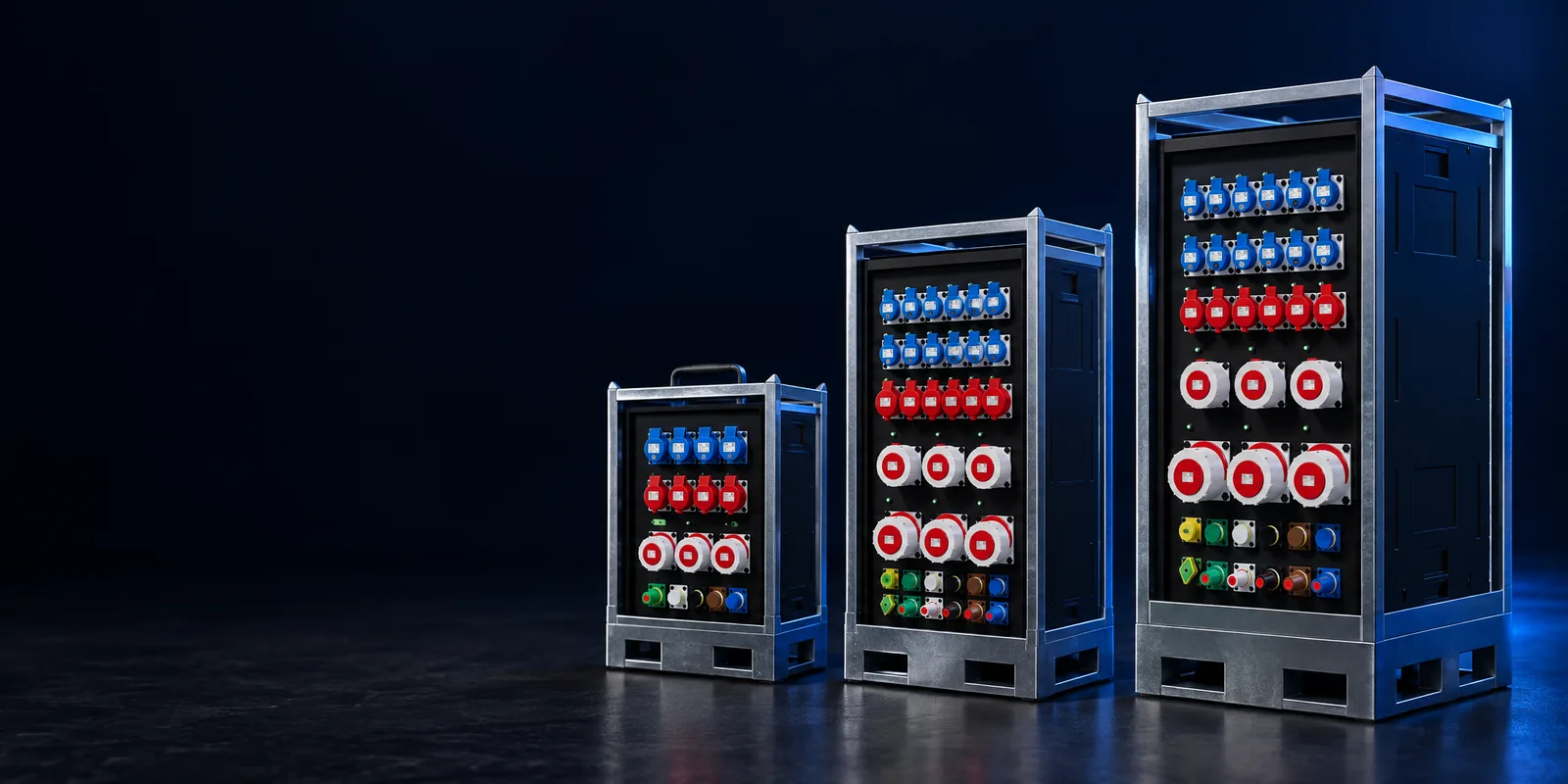
Choosing the right power distribution equipment is essential for keeping an event running safely and reliably. Whether you're powering a small live performance, a corporate conference, a touring production or a large outdoor festival, the distribution system must handle the required electrical load while providing the right outlets and circuit protection.
However, with several event distro sizes available, choosing the right unit isn't always straightforward. A 32A distro may be suitable for a smaller production, while larger setups may require a 63A distro, 125A power distro or 400A power distro, depending on the supply, equipment demand and distribution layout.
In this guide, we'll explain the differences between these ratings, how to estimate your event's power requirements and what to consider when selecting an event power distribution board for your setup.
What Is an Event Power Distro?
An event power distro, also known as a distribution board or power distro box, takes electrical power from a suitable mains supply or generator and distributes it across multiple circuits. These circuits supply equipment such as stage lighting, PA systems, LED screens, catering appliances, exhibition stands and production equipment.
A properly specified distro also incorporates suitable protective devices to help protect downstream circuits and connected equipment.
For temporary installations, the right choice depends on more than the current rating. You must also consider the incoming supply, the number and type of outputs, cable capacity, protective devices, operating environment and how the load will be distributed.
A well-planned temporary event power distribution system helps reduce the risk of overloaded circuits, unwanted trips and avoidable interruptions during an event.
Understanding Event Distro Sizes: 32A vs 63A vs 125A vs 400A
The main difference between these ratings is the amount of current the distribution equipment is designed to handle. Each size serves a different role, from smaller equipment distribution to main event power distribution.
It's important to remember that amperage alone doesn't determine the total available power. The supply voltage and whether the system is single-phase or three-phase also matter.
1. 32A Distro: For Small Events and Local Equipment Distribution
A 32A distro is often suitable for smaller productions and local distribution where the available supply and connected loads fall within its rating.
Typical applications include:
- Small stages and live music setups
- Corporate meetings and presentations
- DJ equipment and compact AV systems
- Small lighting rigs
- Exhibition stands and individual event zones
A 32A unit can distribute power to several downstream circuits, depending on its input configuration and output arrangement.
For example, a three-phase 32A distro may provide multiple single-phase outlets for lighting or AV equipment. A single-phase 32A distro has a different overall capacity, so it's essential to confirm the exact specification before choosing one.
When should you choose a 32A distro?
Choose this size when the equipment demand is relatively modest, the available supply is compatible and the required outlets can be accommodated without exceeding the system's limits.
2. 63A Distro: For Medium-Sized Productions
A 63A distro is a practical option for medium-sized events that need more distribution capacity than a smaller unit can provide.
Typical applications include:
- Medium-sized concert stages
- Corporate events with larger AV requirements
- Lighting and sound distribution
- Marquees and temporary event structures
- Multiple equipment zones supplied from a common feed
Depending on its configuration, a 63A distro can distribute power through several outgoing circuits, allowing production teams to organise their electrical supply by function or location.
For example, lighting, sound and auxiliary equipment can be supplied through appropriately rated outgoing circuits, provided the overall load and phase allocation remain within the system's limits.
When should you choose a 63A distro?
Consider this rating when your event has multiple equipment groups and the calculated demand, supply availability and required output configuration justify a larger distribution unit.
3. 125A Power Distro: For Large Events and High-Demand Equipment
A 125A power distro is commonly used in larger event setups where several substantial loads must be supplied from a central distribution point.
Typical applications include:
- Large concert and touring productions
- Festival stages
- LED video walls and broadcast equipment
- High-demand lighting systems
- Multiple downstream distribution boards
A 125A unit can act as a main distribution point or supply downstream distros, depending on the overall system design. Its output configuration determines how power is divided between smaller circuits and larger equipment feeds.
When should you choose a 125A power distro?
Consider a 125A system when your load calculation and distribution plan require this capacity and the upstream supply, cabling and protection are designed to support it.
It is not necessary to select a larger unit simply because an event is large. The actual electrical demand, equipment characteristics and available supply should determine the specification.
4. 400A Power Distro: For Large-Scale Events and Main Distribution
A 400A power distro is designed for high-capacity distribution applications, including large festivals, major touring productions and multi-zone event sites.
Typical applications include:
- Large outdoor festivals with multiple stages
- Major concerts and touring productions
- Large-scale sports and entertainment events
- Multiple downstream 125A and 63A distribution systems
- Central distribution from a suitably rated generator or electrical supply
A 400A unit can serve as a central distribution point, feeding several downstream systems through appropriately rated outputs. This makes it useful when electrical power must be organised across multiple stages, production areas or other event zones.
For example, a main distro may supply separate distribution boards for stage lighting, sound, video and support areas. The exact arrangement depends on the equipment, the supply and the distribution design.
When should you choose a 400A power distro?
Choose this rating only when the calculated demand, available supply and planned distribution architecture require it. A 400A rating does not mean that 400A is continuously available from every output or that the upstream supply can automatically deliver the full rated current.
Quick Comparison: Which Event Distro Size Do You Need?
Use this table as an initial guide when comparing event distro sizes.
| Distro rating | Typical applications | General role |
|---|---|---|
| 32A | Small stages, compact AV, local lighting | Small-scale distribution |
| 63A | Medium productions, marquees, multiple equipment groups | Intermediate distribution |
| 125A | Large stages, touring rigs, LED walls | High-capacity distribution |
| 400A | Festivals, major concerts, multiple stages | Main event distribution |
These are general application examples, not fixed rules. A small event can have high electrical demand, while a large conference may use relatively little power. Always size the system according to the actual load and electrical design.
How to Calculate Event Power Load Before Choosing a Distro
Before selecting a distro, you need to understand how much power your equipment requires. Knowing how to calculate event power load helps you avoid selecting a system that is too small or unnecessarily large.
Step 1: List All Equipment and Its Power Consumption
Start by creating an equipment schedule that includes everything requiring electricity during the event.
For example:
| Equipment | Quantity | Rated power per unit | Total rated power |
|---|---|---|---|
| LED fixtures | 20 | 200W | 4,000W |
| Audio equipment | 1 set | 3,000W | 3,000W |
| LED screen | 1 | 5,000W | 5,000W |
| Support equipment | 1 group | 2,000W | 2,000W |
| Total | 14,000W (14kW) |
These figures are illustrative. Use the actual equipment specifications, and check whether the stated wattage represents input power, output power or a maximum rating.
Step 2: Identify the Supply Type
Next, determine whether the equipment will be supplied by single-phase or three-phase power.
In a typical UK installation, nominal supply voltages are approximately 230V single-phase and 400V three-phase.
For a single-phase load, a simplified current calculation is:
Current (A) = Power (W) ÷ Voltage (V)
For a 7,000W load supplied at 230V:
7,000 ÷ 230 = approximately 30.4A.
This is already close to a 32A rating, so you must check the actual supply, continuous demand, equipment characteristics and protective-device requirements before selecting the distro.
For a balanced three-phase load, a simplified calculation is:
Current (A) = Power (W) ÷ (√3 × Voltage (V) × Power Factor)
For a 14kW load at 400V with an assumed power factor of 1:
14,000 ÷ (1.732 × 400) = approximately 20.2A per phase.
This is an illustrative calculation, not a final design. Actual current depends on power factor, efficiency, load balance and equipment behaviour. Single-phase loads connected to a three-phase supply must also be assessed on their individual phases.
Step 3: Check Simultaneous Demand and Starting Loads
Not all equipment draws its maximum rated power continuously. At the same time, some equipment can produce high starting currents or changing loads.
Check which equipment will operate simultaneously and review manufacturer specifications for items such as motors, pumps, refrigeration equipment and other loads with significant starting currents.
Do not simply add an arbitrary percentage to the total and assume the system is safe. The appropriate allowance depends on the equipment, operating conditions and applicable design requirements.
Step 4: Check the Complete Distribution System
Once you have calculated the load, verify that the entire system can support it.
Check:
- Incoming supply capacity and connector rating
- Cable current-carrying capacity and voltage drop
- Protective-device ratings and coordination
- Three-phase load balancing
- Required output types and quantities
- Environmental protection for outdoor use
- Suitable earthing and fault protection
A distro is only one part of the electrical system. Its rating must be compatible with the upstream supply and all connected downstream equipment.
Why Three-Phase Distribution Matters at Events
A three-phase distribution box is particularly useful when an event requires substantial electrical capacity across several equipment groups.
Three-phase power distributes the load across three live conductors, helping supply larger installations when designed correctly. The distribution board can then provide suitable outgoing circuits for equipment that uses either single-phase or three-phase power.
However, phase balancing is important. If too much single-phase equipment is connected to one phase, that phase can become overloaded even when the overall system appears to have spare capacity.
A competent electrical professional should assess phase allocation, neutral loading, protective devices and the available supply when planning a three-phase event installation.
What to Check Before Buying an Event Power Distribution Board
Choosing between 32A, 63A, 125A and 400A is only the first step. Before purchasing an event power distribution board, review the following factors.
1. Input and Output Configuration
Confirm that the incoming connector matches the available supply and that the outgoing sockets suit your equipment and downstream distribution boards.
Consider the number of outlets, their current ratings and whether you need single-phase outputs, three-phase outputs or a combination.
2. Circuit Protection
Check the protective devices provided for each circuit. Depending on the design, these may include MCBs, MCCBs, RCDs or RCBOs.
The protection must be appropriate for the circuit, connected equipment, earthing arrangement and intended environment.
3. Outdoor Suitability
Outdoor events can expose equipment to rain, dust, mud and physical impact. Check the IP rating of the enclosure and each relevant connection, along with the manufacturer's stated conditions of use.
An enclosure rating alone does not guarantee that every connected plug, socket or cable joint is equally protected.
4. Portability and Installation
Consider the unit's size, weight, handling requirements and mounting or positioning arrangements. Smaller distros may suit local equipment areas, while larger systems may need dedicated space and planned cable routes.
5. Customisation Requirements
Every event has a different distribution layout. A bespoke distro may be useful if you require a particular combination of outlets, protective devices, metering or input and output connections.
Choosing the right configuration can help simplify installation and make it easier to manage power across different event zones.
Choose the Right Event Distro with Raiden Electric
Selecting the right distro is about matching electrical capacity to real-world requirements, not simply choosing the highest available amperage.
Whether you need a 32A unit for a smaller setup, a 63A distro for a medium-sized production, a 125A system for a large stage or a 400A unit for main event distribution, start with your equipment schedule, available supply and distribution plan.
Raiden Electric offers a range of power distribution boards in 32A, 63A, 125A and 400A configurations, with customisation options for different requirements.
Explore the Raiden Electric distro board range to review available options, or contact the team to discuss a suitable configuration for your event.
The right specification should always be confirmed against the actual electrical load and reviewed by a competent electrical professional before installation or use.
Frequently asked questions
What are the most common event distro sizes?
Common options include 32A, 63A, 125A and 400A. The appropriate size depends on the supply, connected loads, outlet configuration and whether the distro serves a local equipment area or a larger distribution network.
What is the difference between a 32A distro and a 63A distro?
A 63A distro has a higher nominal current rating than a 32A distro, but the available power also depends on whether the system is single-phase or three-phase. The two sizes may also have different input and output configurations.
When do I need a 125A power distro?
A 125A power distro may suit larger stages, touring productions and installations supplying several downstream distribution boards. The calculated demand and available upstream supply should determine whether it is appropriate.
What is a 400A power distro used for?
A 400A power distro is typically used for high-capacity main distribution at large festivals, concerts and multi-zone event sites. It can supply appropriately rated downstream distribution equipment when the complete system is designed for that purpose.
How do I calculate the correct event power load?
List the connected equipment, check its electrical input requirements, calculate the expected simultaneous demand and account for power factor, starting currents and phase allocation where relevant. A competent electrical professional should verify the final supply and distribution design.
Can one distro power an entire event?
Sometimes, but it depends on the total load, the number of equipment zones, the available supply and the distribution layout. Larger events often use a main distro feeding several downstream boards to organise power across stages, lighting, sound and support areas.
What should I look for in a temporary event power distribution system?
Check the current rating, supply compatibility, outlet configuration, protective devices, cable capacity, earthing, phase balance and environmental protection. The equipment should be suitable for the installation conditions and comply with applicable UK electrical requirements.
Can event distro boards be customised?
Yes. Customisation may include outlet combinations, input and output arrangements and other configuration requirements, subject to the manufacturer’s available options and the electrical design.
Need help choosing the right distro?
Visit Raiden Electric to explore the available range and discuss your event power distribution requirements.